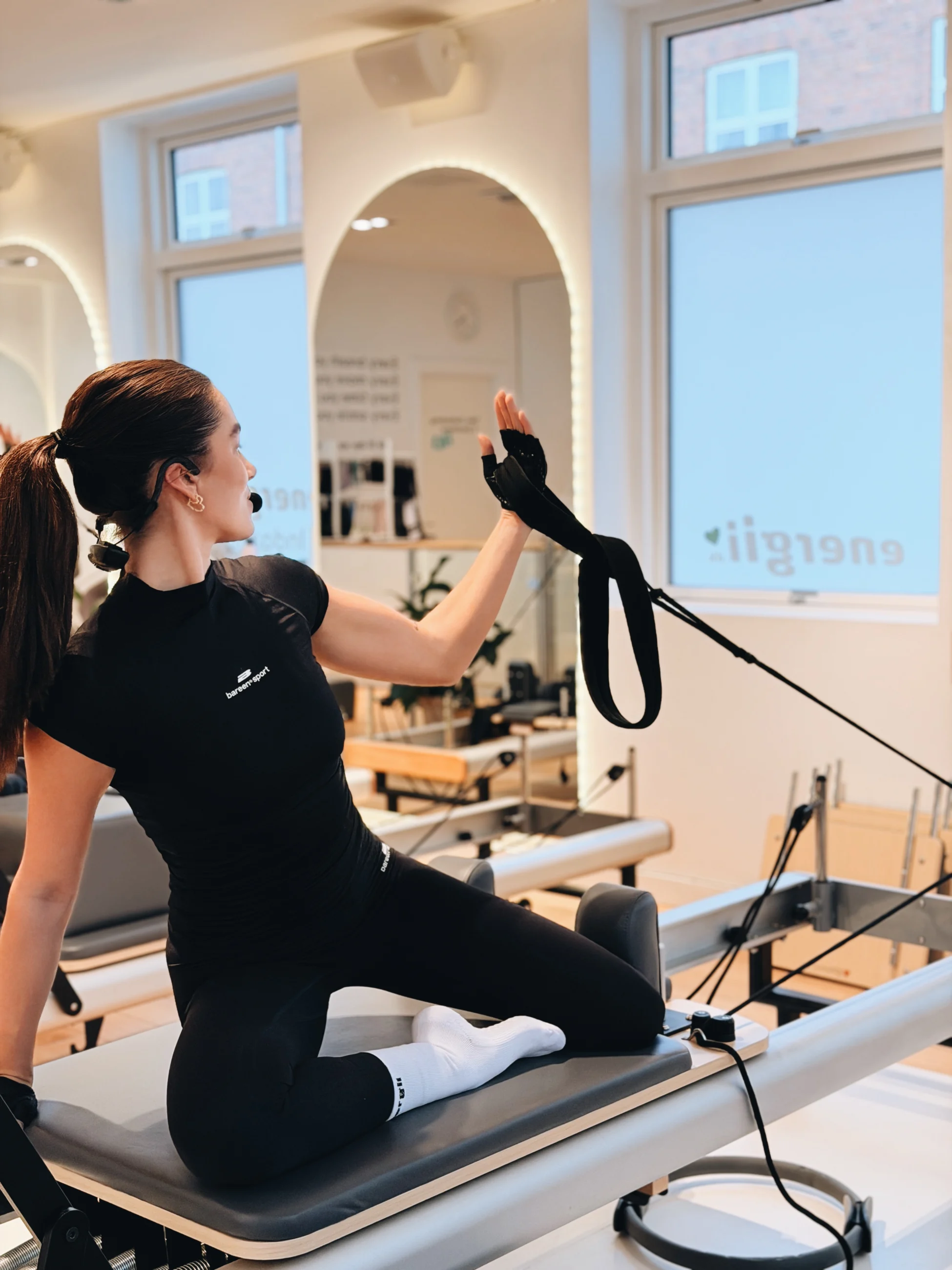
How Pilates Reformer Exercises Transform Your Body — in 30, 60, and 90 Days

TL;DR: In 30 days, your posture and body awareness will improve noticeably. After 60 days, your core strength and balance will have visibly improved. After 90 days, most members report increased strength, better mobility, and a reduction in back and shoulder pain. The prerequisite is 2–3 classes per week—any less than that, and results will be slower to appear.
If you're looking for a workout that will transform your body in 4 weeks with just one session a week—Reformer Pilates isn't the answer. But if you want to see measurable improvements in strength, posture, and pain relief in 8–12 weeks with 2–3 classes a week, here's what you can actually expect.
We’ve seen thousands of members over the course of this timeline. Here’s the honest version—not the “get a six-pack in 4 weeks” hype.
What determines how quickly you see results
Three factors determine how quickly your body adapts to exercise:
1. Training frequency—the most important factor.
Two classes a week is the minimum required for measurable progress. Three classes a week significantly accelerates results. With fewer than two classes a week, you’ll maintain basic body awareness, but structural changes will be minimal.
2. Starting point — complete beginner vs. experienced.
If you’ve been actively working out for years, you’ll notice muscle activation sooner. If you’ve been inactive for 5+ years, you’ll see more significant early progress—because your body responds more strongly to new stimuli.
3. Which metrics you track.
Your energy levels, sleep, and posture change quickly. Visible muscle gain and weight loss take longer. If you’re measuring the wrong thing, you’ll think you’re not seeing results.
Days 1–30: The first thing you’ll notice
Week 1: Muscle soreness and body confusion
You wake up on day 2 and can’t sit down without feeling it in your hamstrings. You discover muscles you didn’t know you had—typically the upper inner thighs, deep core muscles, and the rotator cuff around the shoulder blades.
That's normal. In fact, it's a good sign. The Reformer has engaged stabilizing muscles that your fitness routine or daily life has never worked.
What you might notice: General soreness, difficulty coordinating movements, a feeling that “your body feels different.”
What others see: Nothing yet.
Weeks 2–3: Coordination and Awareness
Your new motor skills are really starting to click. You stay stable on the Reformer without even thinking about it. You’re beginning to understand the resistance of the springs—when a light spring feels heavy (precision work) and when a heavy spring feels light (power work).
You’ll also notice that you sit differently at your desk. You stretch more often. You can tell when your posture starts to slump.
What you'll notice: Greater body awareness throughout the day. Less stiffness after sitting for long periods. Increased energy levels.
What others see: Still not much—but some people notice that you’re sitting up straighter.
Week 4: First visible change in attitude
After 4 weeks of 2–3 sessions per week, your posture will be significantly better. Your shoulders will naturally roll back. Your back will no longer slump in your chair. When you walk, you’ll stand taller.
This is the first noticeable change—and it’s the one that partners, friends, or coworkers most often comment on.
What you'll notice: A noticeable increase in strength during everyday movements (climbing stairs, lifting, getting out of bed). Less lower back soreness after a day of sitting.
What others notice: Better posture. “You look better” without necessarily being able to explain why.
Days 30–60: Visible core, improved balance
What's happening with your core?
Between days 30 and 60, your deep core muscles start to show. It’s not a six-pack yet—it’s the deeper layers, like the transversus abdominis and obliques, that are tightening your stomach from the inside.
Your stomach looks flatter, even though you may not have lost any weight. You look in the mirror and notice that your silhouette has changed.
Balance and coordination
Your knees wobble less when you walk up stairs. You have better balance on one leg. If you participate in other sports—such as running, skiing, or horseback riding—you’ll notice that your control and stability have improved.
This is the result of constant training of the small stabilizing muscles, which the Reformer consistently engages.
Energy and Sleep
Two findings that often surprise members:
- Energy — you have more energy in your daily life, especially in the afternoon.
- Sleep — you sleep more deeply. Reformer training is intense enough to tire the body, but not so intense that it raises cortisol levels in the evening.
Both outcomes are linked to the amount of physical activity, but also to the parasympathetic response elicited by reformer training.
Days 60–90: The strength comes
Measurable increase in strength
After 60–90 days of consistent training, you’ll see a measurable increase in strength:
- You can work on higher springs without any problems
- Team exercises that used to require 100% effort now require 70–80%
- You can hold the plank longer, do more sit-ups, and perform advanced exercises that were impossible in week 1
That is strength—not in terms of muscle mass, but in terms of efficiency and the recruitment of motor units.
Pain that goes away
If you’ve been experiencing lower back pain, shoulder pain, or tension in your hips, you’ll feel significant relief here. This isn’t a coincidence: Reformer Pilates targets the weak muscles around problem areas and strengthens deep stabilizing muscles.
For members with chronic back pain, 8–12 weeks of training is often the point at which they go from “experiencing pain some days” to “being virtually pain-free.” Read our in-depth guide to the Reformer and back pain if that’s your main reason for working out.
The mental shift
The least noticeable but often most significant change: you’ve established a workout routine. You don’t have to wonder whether you’ll go to Reformer class this week—it’s part of your routine.
You’re no longer a “beginner.” You have a level, an attitude, and an opinion about which teams you prefer. That’s when training goes from being “something I try” to “how I train.”
Does Pilates help burn fat? The honest answer
This is the question that gets the most clicks on Google. Here’s the honest answer:
A Reformer class burns 300–500 calories, depending on intensity and body weight. This is comparable to running at a moderate pace for 50 minutes.
But fat loss comes primarily from a calorie deficit in your diet. Reformer Pilates alone won’t take you from 25% to 15% body fat—it takes a combination of exercise and nutrition.
How lifestyle changes can help with long-term weight loss:
- Building muscle increases your resting metabolic rate. More lean muscle mass = higher calorie expenditure, even when you're not working out.
- Better posture changes the way your body looks. You appear slimmer, even if your weight hasn't changed.
- Consistent exercise helps maintain weight loss. Reformer classes have better retention rates than gyms, so people stick with them.
If your goal is pure fat loss in the short term, you should combine strength training with dietary adjustments and possibly a few cardio sessions per week.
Why some members see results faster than others
We’ve seen members transform in just 6 weeks, while others are still struggling to see any change after 6 months. The difference usually comes down to:
1. Frequency. Three sessions per week yield more than 1.5 times the results of two sessions per week. It’s not linear progression—it’s consistency that drives the results.
2. Intensity in every single session. Some members go on autopilot—same weights, same intensity, every time. Others push themselves to add a weight, a rep, or a more challenging variation. The latter see faster progress.
3. Sleep and diet. Exercise doesn’t build muscle. Recovery does. If you sleep 5 hours a night and live on coffee, you’ll stall your progress.
4. Class type. If you only take Mobility & Stretch, you’ll see different results than if you take 2x Signature Reformer + 1x Combat. Both are valuable, but the intensity varies.
How to Speed Up Your Progress
If you want to see faster results without working out more than 3 times a week, focus on:
Frequency before intensity.
Three sessions per week at moderate intensity are better than two sessions per week at high intensity. More training = faster progress, as long as you allow for proper recovery.
Combine with strength training.
For maximum strength gains, add 1–2 days of weight training. This will help you build muscle mass (hypertrophy) in addition to the functional strength that Reformer workouts provide.
Sleep 7+ hours.
Sleep is when muscle tissue repairs itself. Sleep deprivation is the quickest way to halt progress.
Make sure to eat enough protein.
0.8–1 g of protein per kg of body weight per day. For a 70-kg person, that’s 56–70 g of protein per day. That’s about the amount in a small leftover tuna lunch or a protein bar.
Be consistent for 12 weeks.
The single most important factor in achieving visible results is consistency. Inconsistency is the biggest problem among members who “don’t see results.”
Ready to see the change? Get 3 free trial sessions and start your own 90-day journey. Book your trial session →
Frequently Asked Questions
How long does it take to see the results of reforms?
Most members notice improvements in posture and energy levels after 4 weeks of attending 2–3 classes per week. Increased strength and visible core changes become apparent after 8–12 weeks.
Do Pilates reforms burn fat?
Yes, but not as the main goal. A Reformer class burns 300–500 calories. Fat loss comes primarily from a calorie deficit in your diet—Reformer builds muscle mass, which increases your resting metabolic rate.
Should I combine calisthenics with weight training?
For maximum strength gains, yes. Reformer exercises build core strength, control, and mobility. Weight training promotes muscle hypertrophy. The two complement each other.
How often do I need to work out to see a difference?
At least 2 sessions per week. 3 sessions per week significantly accelerate results. More than 4 sessions per week require adequate recovery.
Are there differences in the results between men and women?
Men typically see visible muscle gains more quickly due to testosterone. Women see improvements in strength and posture more quickly. Both see the same percentage increase in strength.
Next step
- Book your free trial class
- Read: What is Reformer Pilates? — Basic Concept
- Read: Reformer Pilates for Strength — If Your Goal Is to Build Strength