What is Reformer Pilates? The Complete Guide to Denmark's Fastest-Growing Form of Exercise
Reformer training is for those who want to strengthen their bodies, improve their posture, and achieve greater flexibility and balance—in a gentle and effective way.

TL;DR: Reformer Pilates is a group class held on a movable Pilates machine with five springs, giving you access to over 600 different exercises in a 50-minute session. It strengthens your core, balance, and control more effectively than both mat Pilates and traditional strength training—because the resistance is adjustable, and the movements force you to be precise.
Reformer Pilates is not yoga. It’s not the same as traditional mat Pilates. And it’s not just a wellness activity either. It’s the fastest-growing form of exercise in Denmark—and if you’ve been thinking about giving it a try, you should understand what you’re actually getting into.
In this guide, we’ll cover everything you need to know: the machine, the team, the physical benefits, how it differs from other forms of exercise, and whether it’s right for you.
What is Reformer Pilates? The short version
Reformer Pilates is a group exercise class in which you perform controlled movements on a Reformer machine—a bench that slides back and forth against the resistance of five springs.
In a 50-minute class, you’ll typically go through 25–40 different exercises that work your entire body: core, legs, back, arms, and the small stabilizing muscles that keep you upright. An instructor guides each movement, adjusts the spring resistance to your level, and challenges you progressively over weeks and months.
The four elements that define Reformer Pilates
- The machine. A reformer is a custom-built bench equipped with springs, straps, a sliding seat, and an adjustable foot bar. It offers a completely different range of motion than any other piece of equipment.
- The resistance. Five springs, each with a different tension, that can be combined to provide everything from very light resistance (rehabilitation, precision) to over 100 kg of total force (strength, power).
- Variety. Over 600 exercises can be performed on the same machine. This means that the same class format can take you from complete beginner to advanced athlete without changing equipment.
- Group format. You’ll work out with 10–14 others under the guidance of an instructor who designs the program and corrects your form in real time. It’s the opposite of working out alone at the gym.
This is exactly what makes Reformers “The Ultimate Workout”—and it’s why more than 20,000 people have chosen to work out at Energii’s 20+ centers across the Nordic region since 2011.
The Reformer — the machine that makes a difference
To understand Reformer Pilates, you need to understand the Reformer machine. It is not a standard piece of fitness equipment. It was invented over 100 years ago by Joseph Pilates, and every detail of its design serves a purpose: to provide the body with the right balance between support and challenge.
This is how a reformer is built
The reform consists of four main parts:
- The bench (carriage) — a rectangular platform on wheels that slides back and forth along a track. This is where you lie, sit, kneel, or stand during the exercise.
- The springs — five springs under the bench, each marked with a different resistance level. They can be engaged and disengaged individually or in combinations.
- Foot bar — a bar at one end where you place your feet or hands to push off the bench. It is height-adjustable.
- Straps — attached at the opposite end. You hold them with your hands or secure them to your feet to pull the bench.
In addition, there are shoulder blocks that keep you in position while you push, as well as a “long box” and a “short box”—two square, padded boxes that are placed on the bench for specific exercises.
The whole setup looks complicated the first time you see it. After two or three rounds, it’s all intuition.
Five springs and over 600 exercises
The most important thing to understand is the spring. A standard Reformer typically has five springs, often marked with different colors, but the principle is the same regardless of the manufacturer: you combine springs to adjust the resistance.
- 1 light resistance band — perfect for rehabilitation, precision exercises, and abdominal exercises.
- 2–3 medium resistance bands — standard for beginners and most leg exercises.
- 4–5 springs fully extended — heavy strength training, push/pull against significant resistance.
It is this flexibility that allows the same reformers to accommodate over 600 different exercises. A beginner and an advanced athlete can train side by side on the same team—one doing footwork with 2 springs, the other doing jumping series with 4 springs. Both receive targeted, level-specific training.
Joseph Pilates developed several hundred Reformer exercises during his lifetime. Modern studies have built on this foundation, and Energii’s exercise library now includes over 600 exercises, which are continuously updated based on members’ needs.
Here's what a typical Reformer class is like
If you've never tried Reformer Pilates before, this is probably your main question: what actually happens in a class?
50-minute workout — warm-up, high-intensity, cool-down
A standard Reformer class at Energii lasts 50 minutes and follows a carefully designed progression:
Minutes 0–10 — warm-up and activation. The instructor starts with exercises that engage the core muscles and get the blood flowing. Typical exercises include footwork (various foot positions against the foot bar), a warm-up bridge, and light work with the straps. You adjust your springs and find your rhythm for the day.
Minutes 10–40 — the main program. This is where the intensity of the workout lies. The program rotates between standing series (legs and glutes), seated arm work (shoulders and upper body), advanced core (crunches on a movable bench are never “just” crunches), and targeted, more challenging exercises that push strength and control. The instructor typically rotates the group through 6–12 different exercises during this phase.
Minutes 40–50 — Stretching and cool-down. The final 10 minutes focus on mobility and cooling down. Stretching using straps, hip openers, and positions that relieve back pain. You’ll leave the class feeling both tired and refreshed.
What the director actually does
This part is crucial—and it’s what sets Reformer Pilates apart from a regular gym.
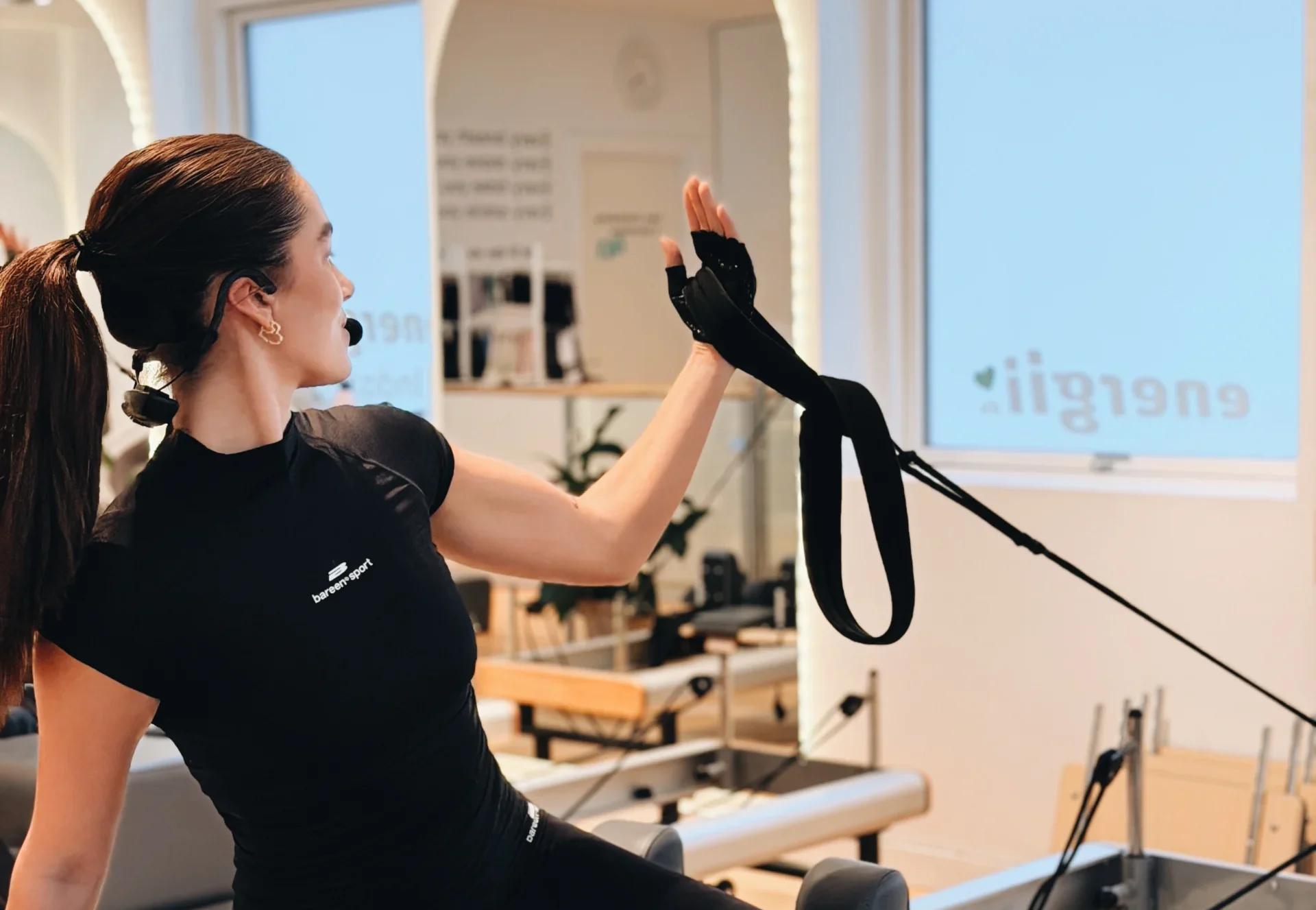
In a reformer class, the instructor doesn't stand in front of you and demonstrate while you copy. The instructor:
- Designs the program with a precise progression—no random exercises.
- Adjusts your form in real time — comes over to you, corrects a hip, a back, a foot.
- Adjusts the resistance for each participant — “remove a spring” or “add one.”
- Includes variations —there’s always an easier and a harder version of each exercise.
It is the team that is the focus. And that is why Reformer instructors at Energii are trained at our own Reformer School in Rødovre—because leading a team requires more than just being able to perform the exercises yourself.
“The Reformer isn’t the machine—the instructor is. The machine provides the opportunity. It’s the person standing at it who turns that into progress. That’s the whole difference.”
— Gitte Mia Salling, founder of Energii
Ready to see for yourself?
You get three free trial sessions so you can try out the concept with no obligation.
What Reformer Pilates Does for the Body
Here’s what the science says—and what we consistently see in members who train 2–3 times a week over a period of 3–6 months.
Strength without bulk
The resistance provided by the springs is more akin to Olympic strength training than to weightlifting: the time under tension is greater, and the movement is slow and controlled throughout the entire range of motion.
This means you build functional strength—power you can use in everyday life, sports, and other forms of exercise—without the hypertrophy (increase in muscle size) that comes with traditional weight training. Your muscles become stronger and more efficient, but not necessarily bigger.
For athletes, this is ideal: more strength, not more weight.
Core, balance, and control
Every exercise on a Reformer forces your core to work—not as a conscious abdominal exercise, but as a natural stabilizing mechanism. When the bench slides and you have to keep your body on track, your core is the only thing keeping you stable.
This is what Pilates was originally designed for. Joseph Pilates called it the “powerhouse”—the center of the body that drives all movement. After 6–8 weeks of consistent training, most members report:
- Improved posture, particularly shoulder and back alignment
- A stronger core without visible bloating
- Better balance in daily activities — stairs, running, lifting
- Reduced stiffness after prolonged sitting
Injury Prevention and Mobility
Reformer Pilates incorporates mobility training—you stretch one muscle while strengthening its counterpart. This is fundamentally different from traditional training, where mobility and strength are usually addressed in separate sessions.
The effect over time:
- Fewer strain injuries to the back, knees, and shoulders
- Better rehabilitation following existing injuries
- Greater movement efficiency in other sports
That is why physical therapists, chiropractors, and sports medicine doctors are increasingly recommending Reformer Pilates as a supplement or alternative to traditional exercise.
Reformer Pilates vs. other forms of exercise
The first question most people ask is: “What’s the difference between reforms and X?” Here are the answers to the three most frequently asked questions.
Reformer vs. Classic Pilates (Mat)
Classic mat Pilates is the foundation. Reformer Pilates is the technological extension that Joseph Pilates himself designed.
- Mat Pilates uses body weight and gravity. The movements are static, and the range of motion is limited by your own body weight.
- Reformer Pilates uses adjustable springs. The movements are dynamic, and the progression is unlimited—from a single light spring to over 100 kg of total resistance.
If you've tried mat Pilates and find it too easy, the Reformer is almost always the answer. You get the same principles—control, precision, concentration—but with resistance that can be adjusted to your level.
Reformers vs. Yoga
This is the most common misunderstanding, and the most important one to clear up.
- Yoga focuses on flexibility, breathing, balance, and—in some forms—mindfulness. The movements are held in place or flow from one position to another. Few forms of yoga result in a significant increase in strength.
- Reformer Pilates focuses on strength, control, precision, and posture. The movements involve repeated repetitions against resistance. Strength and muscle building are central to the practice.
Yoga is an excellent form of exercise. It’s just not the same as Reformer Pilates. Many members at Energii actually combine the two—yoga for flexibility and breathing, and Reformer Pilates for strength and control.
Cardio vs. Strength Training
Here's the interesting thing: Reformer Pilates doesn't compete with strength training. It complements it.
- Traditional strength training builds maximum strength and muscle hypertrophy through isolated movements using free weights or machines.
- Reformer Pilates builds functional strength, core stability, and movement efficiency through complex, multi-muscle movements.
The ideal combination for most members: 2–3 group exercise classes + 1–2 weight training days per week. This gives you both overall strength and deep stability.
The story behind the reformer — from Joseph Pilates to Copenhagen
The Reformer is not a new invention. It was developed by the German physical trainer Joseph Pilates in the 1920s, originally designed to help bedridden patients exercise without leaving their beds. The first Reformers were literally constructed from old hospital beds with springs attached.
Pilates moved to New York in 1926 and opened his own studio in a neighborhood teeming with dancers and athletes. It was quickly discovered by figures such as George Balanchine and Martha Graham, who sent their dancers to him for rehabilitation and body control.
For the next 50 years, Pilates remained a niche discipline—primarily practiced by dancers, athletes, and people undergoing rehabilitation. It wasn’t until the 1990s that the practice began to spread to the general public, particularly in the United States and the United Kingdom.
In Denmark, the first true Reformer studios opened in the early 2010s. Energii was founded in 2011 by Gitte Mia Salling, who had over 25 years of experience in the fitness industry and saw a gap in the market: no one was offering Reformer Pilates as group-based training on a large scale.
Today, Energii has more than 20 centers across the Nordic region, over 300 instructors trained at the Reformer School in Rødovre, and more than 20,000 members. It is Denmark’s first and largest Reformer chain—and a major reason why Reformer Pilates is no longer a niche activity but has become mainstream.
Is Reformer Pilates right for you?
The short answer: yes, probably. The longer answer depends on what you're looking to get out of it.
Who uses Reformers (and why)
In an Energii class, you'll find:
- Beginners — people who have never worked out before, or who are tired of the gym and are looking for structure and results.
- Athletes —runners, cyclists, skiers, and even Olympic athletes—who use Reformers for injury prevention and strength training.
- Men and women of all ages, from 20 to 65+. This isn’t a workout just for women. It’s a workout that’s open to women, men, pregnant women, seniors, athletes—everyone.
- People in rehabilitation —whether after back injuries, knee surgeries, or childbirth. Reformer Pilates is one of the gentlest ways to get back on your feet.
- Fitness veterans — people who have been working out for 15–20 years and are tired of doing the same thing at the gym.
What You Need to Know Before Your First Class
If you've read this far, you've probably decided to give it a try. Here's what you need to know:
- You don't need to be in shape beforehand. The Reformer adapts to you.
- You don't need to have tried Pilates before. Most people in your first class haven't either.
- You'll need form-fitting workout clothes and bare feet—or Pilates socks with non-slip dots.
- You don't need to bring any equipment—everything is provided.
- It's okay to be nervous the first time. Everyone is. After the second class, it'll go away.
At Energii, you get three free trial sessions so you can try out the concept with no obligation. Most members decide to join during the trial period.
Frequently Asked Questions
What is the difference between Reformer Pilates and regular Pilates?
Reformer Pilates uses a machine with springs that provide adjustable resistance. Traditional Pilates is performed on a mat using body weight. As a result, the Reformer offers more precise control over resistance and movement—and thus faster progress.
Is Pilates difficult for beginners?
No. The Reformer has five springs, so the instructor can adjust the resistance to your level. At Energii, there are no prerequisites—just show up for your first class.
How many calories do you burn in a Reformer class?
300–500 calories in 50 minutes, depending on intensity and body weight. High-intensity Reformer classes such as Signature Reformer or Combat are at the higher end of the spectrum.
How often do you need to do Reformer workouts to see results?
2–3 classes a week. Most members notice a difference in their strength and posture after 4–6 weeks.
What should you wear to Reformer Pilates?
Tight-fitting workout clothes—no shorts that ride up. Bare feet or Pilates socks with non-slip dots. No shoes.
Is Pilates dangerous during pregnancy?
Reformer Pilates can be practiced safely throughout most of your pregnancy, but you should inform the instructor before your first class. Certain exercises will be modified, and starting in the second trimester, a gentler version is typically recommended. Always consult your doctor if you have any concerns.
Can men do Reformer Pilates?
Of course. Energii has a growing number of male members, including elite athletes. The Reformer doesn't discriminate based on body type—it adjusts the resistance.
Next step
If you're ready to try Reformer Pilates, here's what you need to do:
- Find your nearest center — Energii has over 20 centers in Denmark, Sweden, and Norway.
- Book your free trial class—you get 3 sessions with absolutely no obligation.
- Read our complete beginner's guide—if you want to know exactly what to expect during your first class.
Ready to see for yourself?
You get three free trial sessions so you can try out the concept with no obligation.