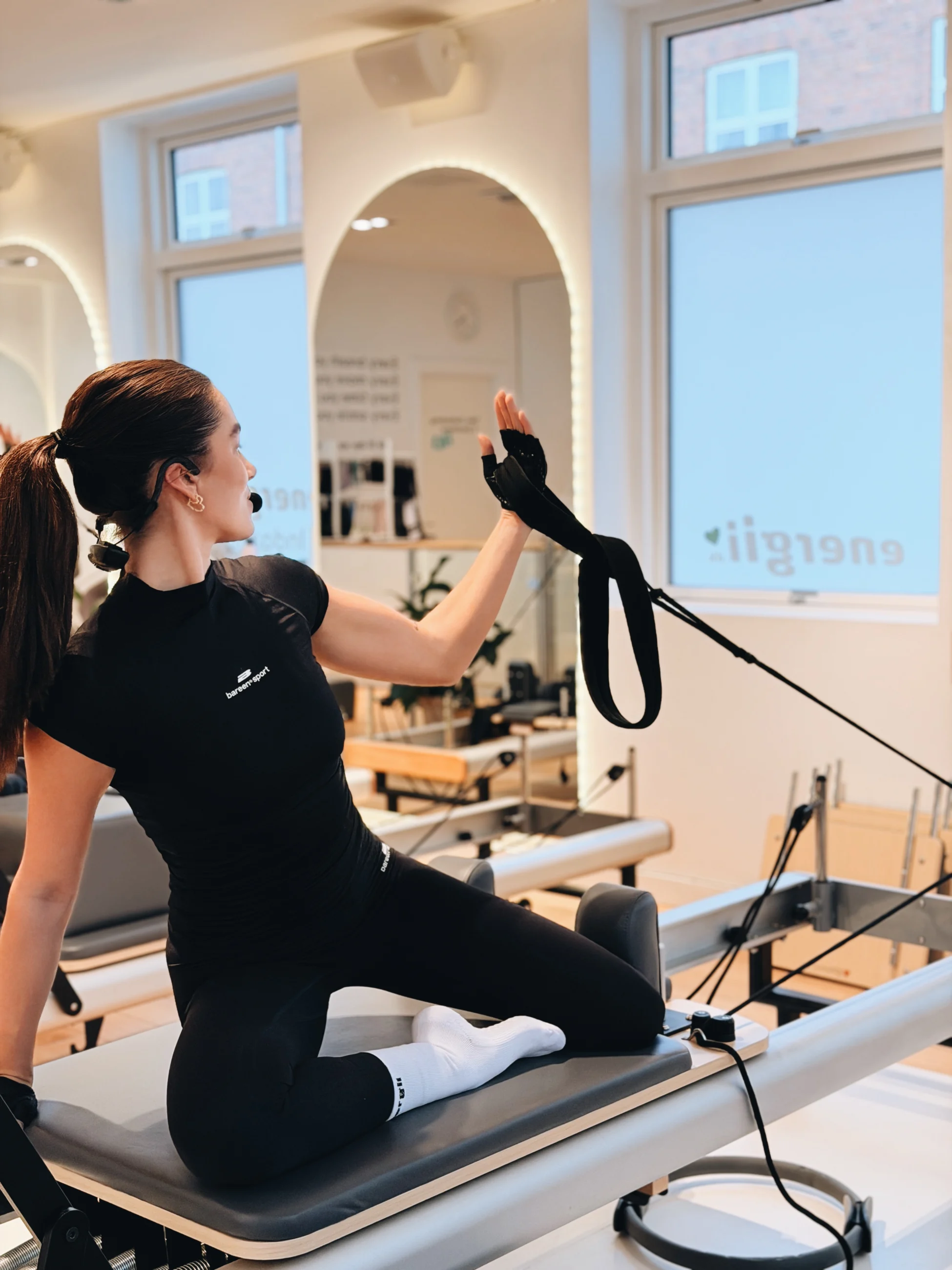
Reformer Pilates for Strength — How to Get Stronger Without a Gym

TL;DR: Reformer Pilates isn’t a substitute for strength training—it’s a supplement that makes you stronger. The resistance from the springs can be calibrated to over 100 kg of total force, and the machine’s biomechanics force you to engage all muscle chains, not just the large ones. The result: better stability, fewer injuries, and more power in basic lifts.
Pilates is for women over 50. Pilates is all about stretching. Pilates doesn't make you strong. If you think it does, you've never worked out on a reformer.
Here’s what the science says about Pilates as a strength-training modality—and why more and more elite male athletes are incorporating it into their weekly routines.
Why Reformer Pilates Is Actually Strength Training
The five springs can generate over 100 kg of resistance
The most common misconception about Reformer Pilates is that the springs provide “light resistance.” This is objectively incorrect.
A standard Reformer has five springs. When fully engaged, they can collectively generate over 100 kg of resistance during pulling movements. During pushing movements—where you push off against the foot bar—you gain additional mechanical advantage from your own body weight and leverage.
To put it in perspective: in a typical pull-up, you’re using your own body weight (usually 60–80 kg for most men). On a reformer, you can pull against 80–100 kg, plus your own weight keeps you on the machine. That’s not “easy.”
Eccentric, concentric, and isometric phases
Every movement on a Reformer consists of three phases:
- Concentric — you push the springs away (the muscle shortens)
- Isometric — you hold a position against resistance (the muscle remains tense)
- Eccentric — you are working against the springs' recoil (the muscle lengthens under tension)
The eccentric phase is crucial. It is this phase that builds pure strength, and it is the one that traditional weight training most often neglects, because exercises are performed quickly on the way back down.
With a Reformer, the eccentric phase is forced —you can’t just let the weight drop. The spring pulls back, and you have to resist it slowly. That extra effort per repetition is a big part of why Reformer training produces such strong results.
Time under tension (TUT) is fundamentally different
Time under tension is a measure used in research to determine how long a muscle is working during a set. Higher TUT = greater stimuli for strength and hypertrophy.
- General strength training: 20–40 seconds of TUT per set
- Reformer Pilates: 45–90 seconds of TUT per set
You work longer against resistance. Every repetition is controlled. As a result, you recruit more muscle fibers during each exercise—including the so-called type II fibers, which are typically activated only during heavy strength training.
How Reformers Can Complement Your Existing Strength Training
What reforms do that weights don't
- It targets the stabilizer muscles in isolation. When the bench slides, it’s your small stabilizer muscles that keep you in control—not your quads or pecs. These muscles rarely get a direct workout at the gym.
- Enforces a neutral spine. You can’t “cheat” on a Reformer by using the momentum of your back. The machine corrects your posture.
- Builds unilateral strength. Many reformer exercises are performed on one side at a time. This reveals and corrects asymmetries (such as a weaker left leg or a dominant right arm), which traditional weight training often reinforces.
- Improves mobility as part of the workout. You stretch while you strengthen. You’ll leave the class with a body that’s both stronger and more flexible.
What weights do that reformers don't
Let's be honest:
- Maximum strength. If your goal is a 200 kg deadlift, reformers aren’t the way to go. You need heavy barbell training.
- Hypertrophy (visible muscle growth). Reformer exercises build functional strength, but not necessarily large muscles. You won’t get “bodybuilder arms” from Reformer exercises alone.
- Power output. Explosive movements such as power cleans or box jumps require weights and bodyweight exercises.
The optimal distribution
For most members who are serious about building strength:
- 2–3 reformer classes per week — for core strength, flexibility, and core stability
- 2–3 strength training days per week — for maximum strength and muscle growth
- 1 rest day, ideally active (walking, light cycling)
That’s 4–6 training sessions a week. That’s a lot—but that’s what it takes to perform at a high level.
The 6 muscle groups you work on a reformer
Reformer Pilates works entire muscle chains, not isolated muscles. Here’s what you’re actually working on:
1. Anterior chain (front)
Quads, hip flexors, abs, and pecs. Trained using footwork drills, the Hundred, and chest expansions.
2. Posterior chain (back)
Glutes, hamstrings, erector spinae, mid-back, rear delts. Trained using bridge sets, rowing, and swan variations.
3. Lateral chain (sides)
Obliques, quadratus lumborum, lateral glutes (gluteus medius). Trained using side-leg series and rotation exercises with straps.
4. Deep stabilizers (the small muscles)
Transversus abdominis, multifidus, pelvic floor, rotator cuff. These muscles are constantly engaged throughout all exercises—that’s what makes Reformer so fundamentally different.
5. Shoulder Complex
Rotator cuff, scapular stabilizers, deltoids. Worked on during arm exercises, plank variations, and rowing.
6. The foot-ankle chain
Often overlooked in traditional training, yet critical to performance. Practiced in all footwork positions—heel, demi-pointe, pointe, parallel, and frog.
It is this breadth of training that allows Reformer exercises to create such an athletic body—one that is not only strong, but also functional, balanced, and efficient.
Reforms for Athletes — Why They're Doing It
Injury Prevention
The main reason elite athletes incorporate Reformer exercises into their routines is injury prevention. Reformer exercises identify and correct imbalances before they lead to injuries.
For a runner, this means that a weak right gluteus medius (the most common cause of iliotibial band syndrome) can be identified and corrected on a Reformer before it manifests as knee pain.
For a skier, this means that the deep core muscles, which absorb the impact during descents, are trained to perform—so your back doesn’t ache after a week on the slopes.
Power transfer and asymmetry correction
Athletes are rarely symmetrical. The dominant side is stronger and more coordinated. Reformers eliminate this “cheating”—you can’t compensate with your strong side because the exercises are often unilateral or require equal bilateral coordination.
The result is better power transfer —the ability to convert force in one area (e.g., the legs) into power in another (e.g., the swing of a golf club).
Examples
Energii has trained elite athletes in equestrian sports, cycling, running, and rowing. The common experience: after 8–12 weeks of Reformer training, athletes report:
- Less stiffness after competition
- Better balance in their specific sport
- Reduction in recurring injuries
These are results you rarely achieve in your main sport.
Reforms for Men — Challenging Prejudices
Let’s get right to the point: Reformer Pilates has an image problem among men. It’s seen as “a workout for women,” “too gentle,” and “not serious.”
That's wrong.
At Energii, the number of male members has increased every year since 2020. They are typically:
- Aged 30–50. Has been training in fitness or CrossFit for over 10 years.
- Tired of the same old routine. Looking for something that challenges them in new ways.
- Plagued by injuries. Reformers help with back, shoulder, and knee pain.
- Sports-oriented. They play golf, ski, and run—and want to have an edge over their peers.
They don't come to stretch. They come to get stronger, more flexible, and less prone to injury.
If you're a man thinking about getting a makeover, know this: you won't be the only one on the team. Nor will you be the weakest—the springs will adjust to you, and you'll build strength quickly.
See also: 5 myths about Reformer Pilates — where we debunk each one.
How to Incorporate Changes into Your Weekly Workout Routine
Schedule 1: Performance-oriented (4–5 sessions per week)
- Monday: Weight training (compound exercises—squats, deadlifts, bench press)
- Tuesday: Reformer (Signature Reformer or Combat)
- Wednesday: Rest or light cardio
- Thursday: Weight training (compound exercises + accessories)
- Friday: Reformer (Signature Reformer)
- Saturday: Sports or interval training
- Sunday: Rest
Schedule 2: Strength + Flexibility (3 sessions/week)
- Monday: Reformer (Signature Reformer)
- Wednesday: Weight training (full body)
- Friday: Reformer (Combat — for cardio and strength)
Schedule 3: Reforms-focused with supplementary weight training (3–4 sessions per week)
- Monday: Reforms
- Tuesday: Weight training (light, focusing on accessories)
- Thursday: Reforms
- Saturday: Reforms or sports
Which type of reform team?
- Signature Reformer — Energii’s advanced concept: high-intensity, full-body workout
- Combat — cardiovascular + strength training, perfect for performance-oriented individuals
- Heat It Up® — a game-changer in infrared heating, significantly increasing flexibility
- Essence Pilates — moderate intensity, foundation-focused
Most men start with the Signature Reformer and add the Combat or Heat It Up® over time.
Ready to see what Reformer can really do? Book your strength assessment with an instructor →
Frequently Asked Questions
Can you build strength through Reformer Pilates?
Yes. The Reformer’s five springs can generate over 100 kg of resistance, and the eccentric phase of each movement recruits muscle fibers in a way that increases both strength and hypertrophy.
Is Reformer Pilates enough on its own?
For most members, yes. For athletes and people with specific strength goals, Reformers work best as a supplement to 1–3 days of weight training per week.
Can men do Reformer Pilates?
Of course. Energii has a growing number of male members, including elite athletes. The Reformer doesn't discriminate based on body type—it adjusts the resistance.
How much force do I need to be able to pull or push?
It's entirely up to you. The spring tension is adjusted to your skill level. Beginners start with 2 springs; more experienced users work with 4–5.
What is the difference between the Signature Reformer and a standard Reformer?
Signature Reformer is Energii’s own high-intensity version. More power, more pace, more progression—for members who want to push themselves harder.